Optical Filters for Stereo mini Cameras#
More specifically, the optical characteristics of different filter types are investigated and then camera performance under challenging lighting conditions is optimized using appropriate optical filters. The improved image quality is demonstrated in test images.
简介#
The performance of Stereo mini cameras is directly related to the quality of the stereo image pairs. Therefore, in certain scenarios, it's beneficial to use additional optical components to enhance the imaging quality of the stereo cameras, thereby improving the performance of the depth perception. In this document, the focus is primarily on optical filters, which can avoid critical imaging issues if applied appropriately and are generally available at affordable cost.
What is an Optical Filter?#
An optical filter is an optical component designed to selectively transmit or block specific wavelengths of light. They are typically made of specific materials or coated with films to achieve the desired optical properties, i.e., they are used to control the propagation of light in optical systems.
Types of Optical Filters#
Neutral Density Filter#
These filters are designed to reduce the intensity of incident light. This filtering action is non-selective, meaning it reduces the intensity of light for all wavelengths equally, thereby decreasing the transmitted light intensity without affecting the spectral distribution of the light. In photography, they're commonly used to prevent saturation in high dynamic range images. In laser applications, they're typically used for controlling laser power.
Broadband Filter#
These filters selectively transmit a certain wavelength band of light while blocking other wavelengths. They're classified into short-pass, bandpass, and long-pass filters, each allowing specific wavelength ranges to pass through while attenuating others. Different bandpass filters are chosen based on the desired transmittance characteristic over the spectra of interest. The following diagram illustrates the spectral distribution curves of different types of bandpass filters.
Bandpass Filter#
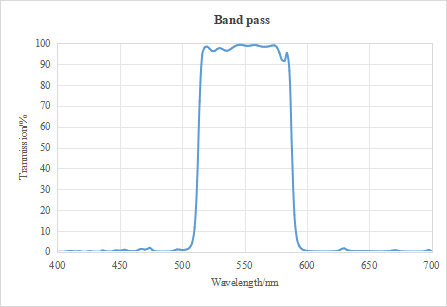
This filter selects a specific wavelength band to pass through while attenuating wavelengths outside the pass band. The following image shows an example.

Short-Pass Filter#
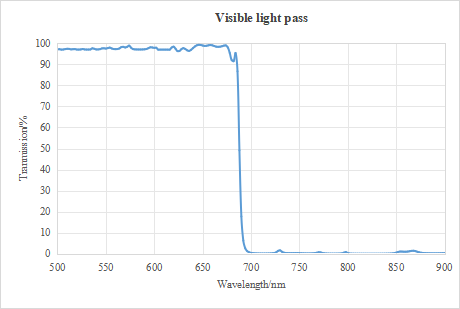
This filter allows light shorter than the selected wavelength to pass through while blocking light longer than that wavelength. Common examples include visible light pass filters, as shown in the following image.

Long-Pass Filter#
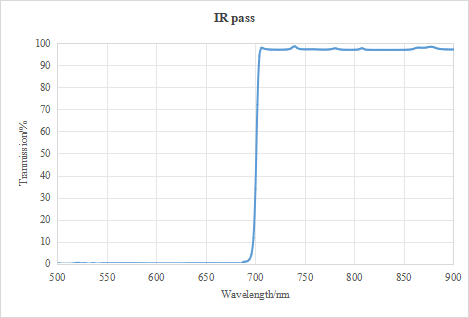
This filter allows light of wavelengths longer than the selected value to pass through while blocking light of wavelengths shorter than the selected value. Typical examples are IR pass filters with visible light cut-off. The following image shows an example.

Band-Stop Filter#
This filter blocks only a specific wavelength band of light and is essentially the opposite of a bandpass filter. It's commonly used to eliminate light of a particular wavelength and plays an important role in scientific applications such as fluorescence microscopy imaging.
Polarizing Filter#
This type of filters is used to adjust the polarization state of incident light. Common types of polarized light include linearly polarized light, circularly polarized light, and elliptically polarized light. This type of filter is used in applications such as laser polarization imaging, liquid crystal displays, and sunglasses.
Challenges of Stereo mini Cameras#
Sensitivity to Ambient Light#
Stereo vision usually captures image pairs with ambient light in the environment. However, differences in light intensity and incident light angles between the left and right cameras can lead to significant differences in brightness between the left and right images of a stereo pair, resulting in a sharp decline in algorithmic matching effectiveness.
Poor Performance in Monotonous and Textureless Scenes#
Stereo vision relies on visual features for image matching. Therefore, scenes lacking visual features, such as the sky or white walls, can pose matching difficulties, leading to significant matching failures or even errors. Adding laser speckle projection can enhance features in low-texture scenes. In certain situations, however, ambient light can reduce the contrast of laser speckles or even obscure their grayscale information.
Using Filters#
Filtering Out Ambient Light#
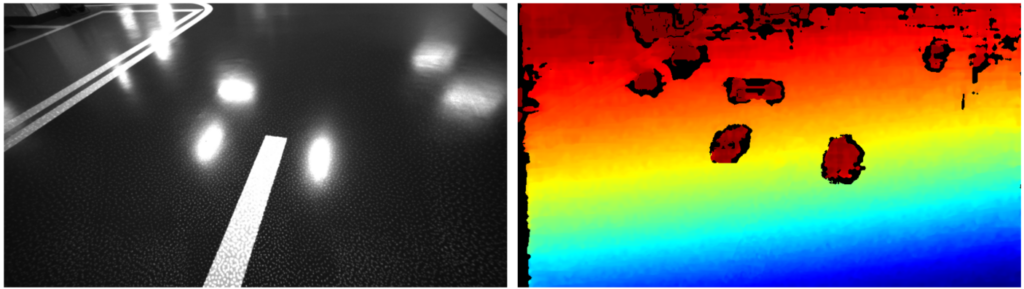
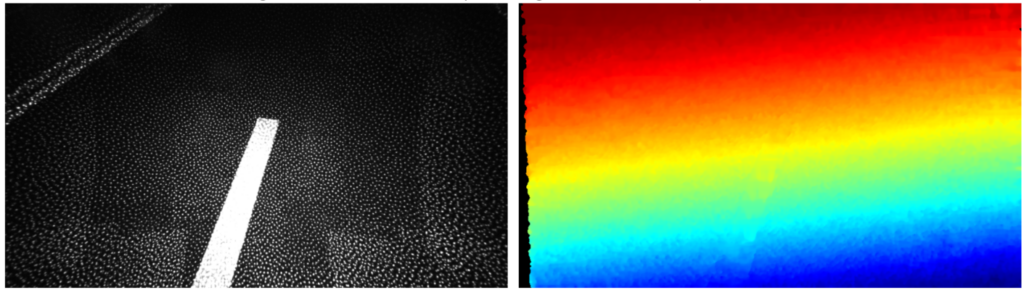
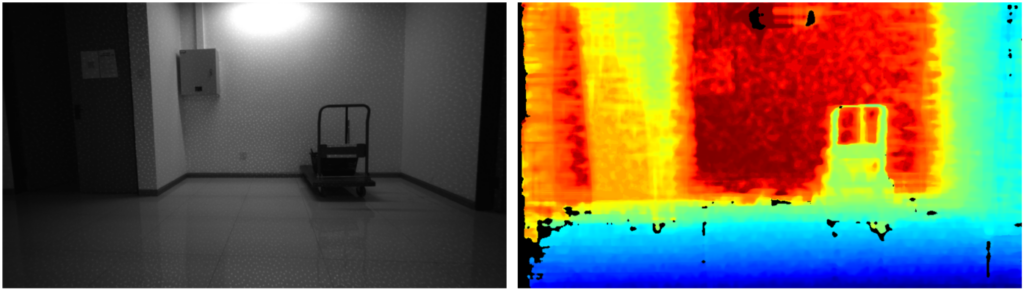
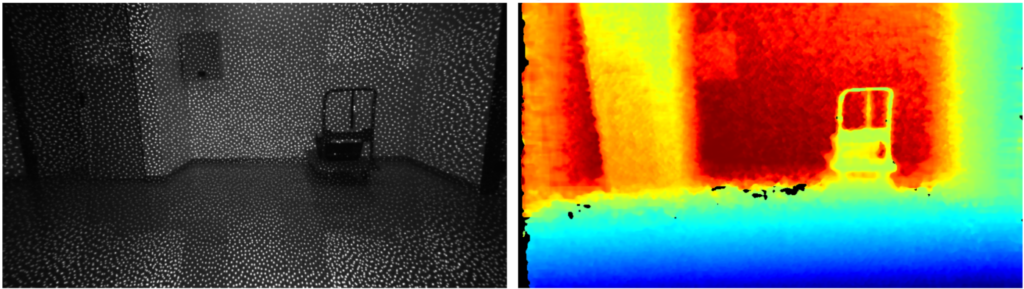
The majority of ambient light in indoor scenes consists of visible light, with its spectrum concentrated in the 400 to 600 nm range. For Stereo mini cameras, areas with high brightness or highly reflective objects can result in incorrect depth calculations due to excessive ambient light. Adding an IR pass filter effectively suppresses overexposed areas caused by ambient light, ensuring the accuracy of depth calculation. The following images show a comparison of before and after adding the IR pass filter. By adding a filter, the depth performance of the ground has significantly improved.


Enhancing Speckle Signal-to-Noise Ratio (SNR)#
The signal-to-noise ratio (SNR) of laser speckles in Stereo mini cameras has a great impact on imaging quality. Ambient light introduces background noise to laser speckles, resulting in poor SNR or even overshadowing of speckle brightness. Adding an IR pass filter to eliminate visible light effectively improves the speckle SNR, especially in low-texture scenes, thereby enhancing imaging quality. The following images show a comparison of before and after adding the IR pass filter. By adding a filter, the depth performance of the light tube and the cart has significantly improved.